Local News
Ann Arbor Art Fair 2026: What Locals Need to Know About Traffic, Parking, and the 30-Block Downtown Takeover
By Staff · July 17, 2026
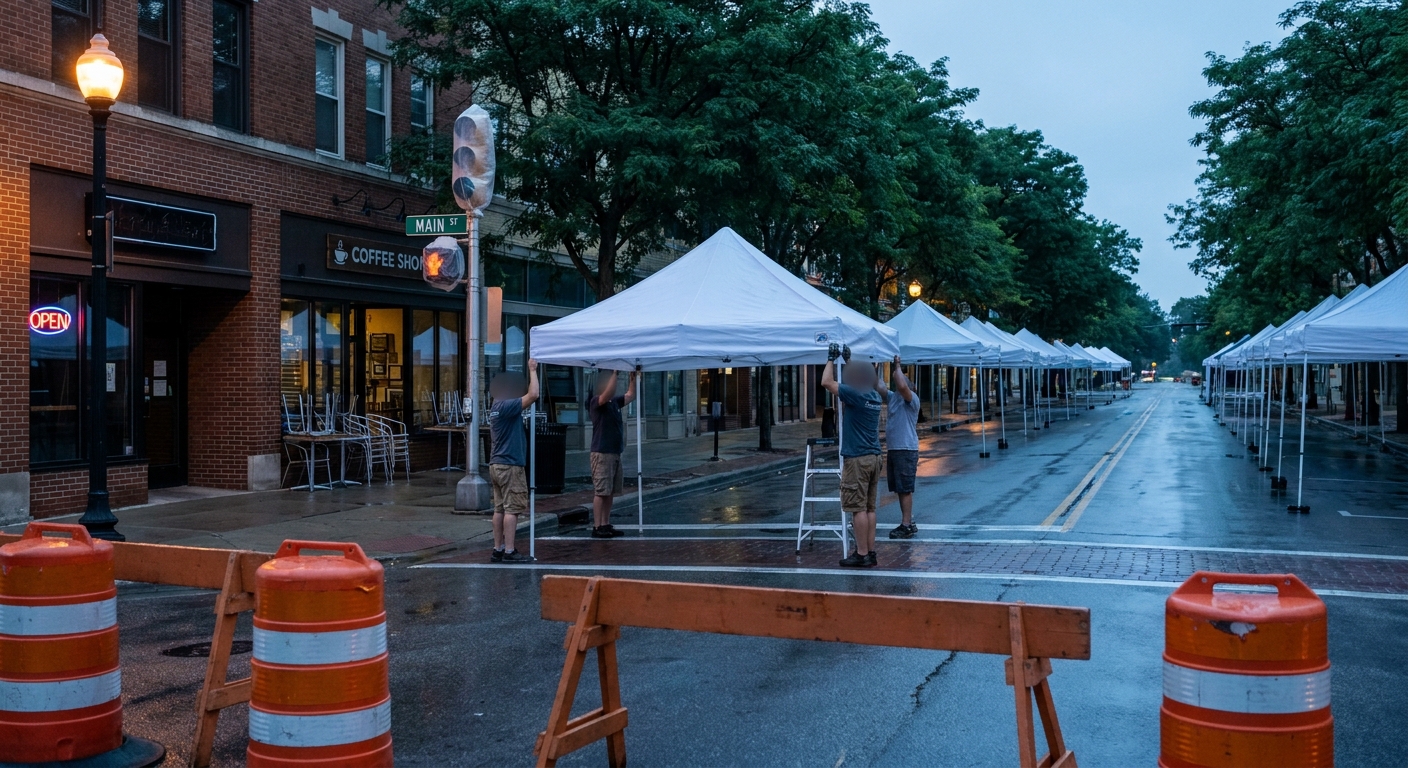
By 6 a.m. Tuesday, the streets many Ann Arbor residents and downtown workers use to cross the city began turning into a festival footprint of tents, detours and restricted access. For three days, downtown Ann Arbor stops operating on its usual terms.
The 2026 Ann Arbor Art Fair opened Thursday, July 16, and runs through Saturday, July 18, bringing more than 400,000 visitors, nearly 1,000 jury-selected artists and a footprint across 30 downtown blocks. That is a major opportunity for artists, restaurants, hotels and retailers built to catch a passing crowd. For residents, downtown workers and businesses whose customers need to drive in, it means detours, lost parking and a decision: absorb the disruption or get out of its way.
Wildfire smoke from Canada and Minnesota already reshaped the opening-day schedule. Organizers allowed artists to close their booths at 3 p.m. Thursday and reopen at noon Friday, instead of keeping the usual 10 a.m. to 9 p.m. schedule. The fair is still scheduled to run from 10 a.m. to 8 p.m. Saturday.
The event is made up of three nonprofit fairs: the Ann Arbor Street Art Fair (The Original), the Ann Arbor State Street District Art Fair and the Ann Arbor Summer Art Fair, run by The Guild of Artists & Artisans.
Street closures started at 6 a.m. Tuesday, July 14 — two days before the public opening — and continue through the end of Saturday, July 18.
Closures scheduled from 6 a.m. Tuesday, July 14 through midnight Saturday, July 18 include:
- Liberty Street from Ashley to South State
- Main Street from William to Huron
- East Washington Street from South Thayer to Fletcher
- North University Avenue from South State to Fletcher
- South University Avenue from South State to Forest
- Church Street from Willard to South University
- Thompson Street from East Liberty to West William
North University Avenue between Fletcher and State is closed to vehicles for the full fair week. Willard Street is fully closed to vehicular traffic during the fair. Packard Street is closed between Division and Hill and between Hill and State, while Hill Street remains open through Packard.
In practice, the Main–State–South University corridor becomes a choke point for anyone trying to cross downtown, get to work or reach a business beyond the fair boundary. The City of Ann Arbor is urging drivers to allow extra time and check closure maps before leaving.
Parking is where the fair's upside becomes a direct cost for the people who use downtown every day. Downtown structures and lots are charging flat daily rates of $18 to $20, with discounts after 5 p.m. Regular Residential Parking Permits do not override Art Fair closures; streets inside the fair zone are closed to general traffic, and parking is prohibited without a special Art Fair Authorized permit.
Free remote parking is available at Huron High School, 2727 Fuller Road, and at Briarwood Mall behind JCPenney. Both lots connect to downtown by paid shuttle. A round-trip shuttle wristband costs $9 per person. Buses run every 10 to 15 minutes from 9 a.m. to 10 p.m. Thursday and Friday, and from 9 a.m. to 9 p.m. Saturday. Children 5 and younger ride free. A separate Art-Go-Round shuttle, which is free, air-conditioned and wheelchair accessible, circulates around the fair area.
The fair generates an estimated $78 million to $80 million in economic impact for the community. Artists' sales, restaurant meals, retail purchases and hotel stays all feed that total. The fair's Grab & Go program steers attendees toward downtown restaurants selling ready-to-eat meals, and the event is a major summer driver of hotel occupancy.
"You come here, you're here for the art, you're here for the restaurants and the merchants, but there's also entertainment as well," Ann Arbor Mayor Christopher Taylor said.
Still, a crowd this large is not an automatic win for every business inside the footprint. Restaurants and retailers that can serve fast-moving festival traffic may benefit. Businesses that depend on appointments, vehicle access or a quieter setting can lose their regular customers instead. Some downtown businesses see revenue fall because Art Fair visitors are not their target customers; some close for four days during the Art Fair period. The same audience that creates demand for one merchant can effectively block access to another's customers.
Many Ann Arbor residents leave town during the Art Fair to avoid the crowds and traffic disruption. For those who remain and can postpone a downtown trip, avoiding the fair footprint may be the simplest plan. Friday morning before the adjusted noon reopening and Saturday after the 8 p.m. close offer the clearest windows, though road closures remain in effect.
Workers who must commute downtown face a more direct choice: $18 to $20 per day for downtown parking, $9 for a remote-lot shuttle wristband, or another transportation option entirely. For three days, getting through downtown is less about finding the fastest route than deciding whether the trip is worth making at all.